Namespaces | |
| namespace | internal |
Classes | |
| class | AnyOf |
| Groups arguments for presentation without imposing a selection rule. More... | |
| class | Arg |
| A virtual base class that defines the essential data for all arguments. More... | |
| struct | ArgAlias |
| An additional short flag and/or long name for the same argument. More... | |
| class | ArgContainer |
| Interface that allows adding an Arg to a "container". More... | |
| class | ArgException |
| A simple class that defines and argument exception. More... | |
| class | ArgGroup |
| ArgGroup is the base class for implementing groups of arguments that are mutually exclusive (it replaces the deprecated xor handler). More... | |
| class | ArgParseException |
| Thrown from within the child Arg classes when it fails to properly parse the argument it has been passed. More... | |
| class | ArgTraits |
| Arg traits are used to get compile type specialization when parsing argument values. More... | |
| struct | ArgTraits< std::string > |
| class | CmdLine |
| The base class that manages the command line definition and passes along the parsing to the appropriate Arg classes. More... | |
| class | CmdLineInterface |
| The base class that manages the command line definition and passes along the parsing to the appropriate Arg classes. More... | |
| class | CmdLineOutput |
| The interface that any output object must implement. More... | |
| class | CmdLineParseException |
| Thrown from CmdLine when the arguments on the command line are not properly specified, e.g. More... | |
| class | Constraint |
| The interface that defines the interaction between the Arg and Constraint. More... | |
| class | DeferDelete |
| DeferDelete can be used by objects that need to allocate arbitrary other objects to live for the duration of the first object. More... | |
| class | DocBookOutput |
| A class that generates DocBook output for usage() method for the given CmdLine and its Args. More... | |
| class | EitherOf |
| Implements a group of arguments where at most one can be selected. More... | |
| class | ExclusiveArgGroup |
| Implements common functionality for exclusive argument groups. More... | |
| class | ExitException |
| Thrown when TCLAP thinks the program should exit. More... | |
| class | GreaterThanConstraint |
| Accepts values strictly greater than an owned lower bound. More... | |
| class | GreaterThanOrEqualConstraint |
| Accepts values greater than or equal to an owned lower bound. More... | |
| class | HelpVisitor |
| A Visitor object that calls the usage method of the given CmdLineOutput object for the specified CmdLine object. More... | |
| class | IgnoreRestVisitor |
| A Visitor that tells the CmdLine to begin ignoring arguments after this one is parsed. More... | |
| class | LessThanConstraint |
| Accepts values strictly less than an owned upper bound. More... | |
| class | LessThanOrEqualConstraint |
| Accepts values less than or equal to an owned upper bound. More... | |
| class | MultiArg |
| An argument that allows multiple values of type T to be specified. More... | |
| class | MultiSwitchArg |
| A multiple switch argument. More... | |
| class | OneOf |
| Implements a group of arguments where exactly one must be selected. More... | |
| class | OptionalUnlabeledTracker |
| class | PredicateConstraint |
| Adapts an owned function or const function object to Constraint<T>. More... | |
| class | RangeConstraint |
| A Constraint that requires a value to fall within a closed [min, max] range, for the common "between X and Y" case that otherwise requires writing a full Constraint<T> subclass by hand. More... | |
| class | SpecificationException |
| Thrown from Arg and CmdLine when an Arg is improperly specified, e.g. More... | |
| class | StandaloneArgs |
| class | StdOutput |
| A class that isolates any output from the CmdLine object so that it may be easily modified. More... | |
| struct | StringLike |
| A string like argument value type is a value that can be set using operator=(string). More... | |
| struct | StringLikeTrait |
| A class can inherit from this object to make it have string like traits. More... | |
| class | SwitchArg |
| A simple switch argument. More... | |
| class | UnlabeledMultiArg |
| Just like a MultiArg, except that the arguments are unlabeled. More... | |
| class | UnlabeledValueArg |
| The basic unlabeled argument that parses a value. More... | |
| class | ValueArg |
| The basic labeled argument that parses a value. More... | |
| struct | ValueLike |
| A value like argument value type is a value that can be set using operator>>. More... | |
| struct | ValueLikeTrait |
| A class can inherit from this object to make it have value like traits. More... | |
| class | ValuesConstraint |
| A Constraint that constrains the Arg to only those values specified in the constraint. More... | |
| class | VersionVisitor |
| A Visitor that will call the version method of the given CmdLineOutput for the specified CmdLine object and then exit. More... | |
| class | Visitor |
| A base class that defines the interface for visitors. More... | |
Typedefs | |
| typedef std::list< Arg * >::const_iterator | ArgListIterator |
| Typedef of an Arg list iterator. | |
| typedef std::vector< Arg * >::const_iterator | ArgVectorIterator |
| Typedef of an Arg vector iterator. | |
| typedef std::list< Visitor * >::const_iterator | VisitorListIterator |
| Typedef of a Visitor list iterator. | |
| typedef std::istringstream | istringstream |
| typedef std::ostringstream | ostringstream |
Functions | |
| template<typename T > | |
| void | ExtractValue (T &destVal, const std::string &strVal, ValueLike vl) |
| template<typename T > | |
| void | ExtractValue (T &destVal, const std::string &strVal, StringLike sl) |
| int | CountVisibleArgs (const ArgGroup &g) |
| bool | isInArgGroup (const Arg *arg, const std::list< ArgGroup * > &argSets) |
| void | removeArgsInArgGroups (std::list< Arg * > &argList, const std::list< ArgGroup * > &argSets) |
| std::string | removeSuffix (std::string s, const std::string &suffix) |
| std::string | basename (std::string s) |
| template<class T , class Function > | |
| PredicateConstraint< T, Function > | MakeConstraint (const std::string &description, const std::string &shortId, Function function) |
| Creates an owning constraint with fixed presentation text. | |
| template<class T , class Rule > | |
| PredicateConstraint< T, Rule, internal::RuleConstraintText > | MakeRuleConstraint (Rule rule) |
| Creates an owning rule constraint. | |
| template<typename T > | |
| void | SetString (T &dst, const std::string &src) |
| void | removeChar (std::string &s, char r) |
| bool | cmpSwitch (const char &a, const char &b) |
Variables | |
| const char | PATH_SEPARATOR |
Typedef Documentation
◆ ArgListIterator
| typedef std::list<Arg*>::const_iterator TCLAP::ArgListIterator |
◆ ArgVectorIterator
| typedef std::vector<Arg*>::const_iterator TCLAP::ArgVectorIterator |
◆ istringstream
| typedef std::istringstream TCLAP::istringstream |
◆ ostringstream
| typedef std::ostringstream TCLAP::ostringstream |
◆ VisitorListIterator
| typedef std::list<Visitor*>::const_iterator TCLAP::VisitorListIterator |
Function Documentation
◆ basename()
|
inline |
Definition at line 110 of file CmdLineOutput.h.
References PATH_SEPARATOR, and removeSuffix().

◆ cmpSwitch()
|
inline |
Definition at line 193 of file StdOutput.h.
◆ CountVisibleArgs()
|
inline |
Definition at line 246 of file ArgGroup.h.
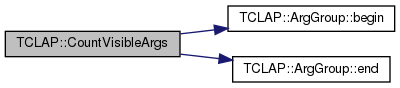
References TCLAP::ArgGroup::begin(), and TCLAP::ArgGroup::end().
Referenced by TCLAP::DocBookOutput::printLongArg().
◆ ExtractValue() [1/2]
| void TCLAP::ExtractValue | ( | T & | destVal, |
| const std::string & | strVal, | ||
| StringLike | sl | ||
| ) |
Definition at line 518 of file Arg.h.
References SetString().

◆ ExtractValue() [2/2]
| void TCLAP::ExtractValue | ( | T & | destVal, |
| const std::string & | strVal, | ||
| ValueLike | vl | ||
| ) |
Definition at line 470 of file Arg.h.
Referenced by TCLAP::MultiArg< T >::_extractValue(), and TCLAP::ValueArg< T >::_extractValue().
◆ isInArgGroup()
Definition at line 79 of file CmdLineOutput.h.
Referenced by removeArgsInArgGroups().
◆ MakeConstraint()
| PredicateConstraint< T, Function > TCLAP::MakeConstraint | ( | const std::string & | description, |
| const std::string & | shortId, | ||
| Function | function | ||
| ) |
Creates an owning constraint with fixed presentation text.
T is explicit; the callable type is deduced. C++98 callers normally construct the adapter directly because storing a factory result requires spelling its type.
Definition at line 159 of file PredicateConstraint.h.
◆ MakeRuleConstraint()
| PredicateConstraint< T, Rule, internal::RuleConstraintText > TCLAP::MakeRuleConstraint | ( | Rule | rule | ) |
Creates an owning rule constraint.
Rule supplies a const operator()(const T&), description() and shortID(); both text methods return std::string. Presentation observes the same rule object that validates values.
Definition at line 171 of file PredicateConstraint.h.
◆ removeArgsInArgGroups()
|
inline |
Definition at line 89 of file CmdLineOutput.h.
References isInArgGroup().

◆ removeChar()
|
inline |
Definition at line 186 of file StdOutput.h.
◆ removeSuffix()
|
inline |
Definition at line 101 of file CmdLineOutput.h.
Referenced by basename().
◆ SetString()
| void TCLAP::SetString | ( | T & | dst, |
| const std::string & | src | ||
| ) |
Definition at line 55 of file StandardTraits.h.
Referenced by ExtractValue().
Variable Documentation
◆ PATH_SEPARATOR
| const char TCLAP::PATH_SEPARATOR |